
If you’re still choosing attorneys the way everyone says you should, you’re setting yourself up for disappointment.
Googling “best lawyer near me,” scrolling through glossy websites, or counting up those shiny five-star reviews is a good way to get burned in the end.
Law firm review pages? Half of them are a graveyard of fake testimonials and bored receptionists hyping up the boss. Google will eventually wipe out the obvious fakes in a quarterly sweep, but the damage is always done before anyone notices.
However, reviews are just one trap.
Social media’s full of Day in the Life lawyer clips and LinkedIn flexing, but behind the filtered smiles and “client-first” hashtags, you’re still guessing. The truth is most people are just winging it, and hoping their lawyer won’t end up being the legal version of ordering DoorDash at midnight and praying the food is still hot.
Before we even get to the punchline, let’s break down the usual advice you’ll find everywhere else: reviews, referral networks, and those “top 10” lists with more fine print than an insurance policy. I’ll tell you why those rarely lead to the lawyer you actually need.
How Law Firm Reviews Work ⭐️⭐️⭐️⭐️
Most people begin their attorney search with Google or Yelp. That first page of reviews (usually) looks comforting, especially when a law firm sports a parade of five-star ratings and gushing testimonials. But the numbers behind those stars? They’re almost always a joke.
The Collapse of Trust in Reviews
Multiple consumer studies over the past few years have shown that trust in online reviews is dropping fast. In 2023, BrightLocal found that just 34% of consumers said they “always” trust reviews, down from 40% in 2022. Most people, especially Gen Z and Millennials (otherwise known as the wisest generations) say they only trust reviews if there’s something real about them: details, receipts, a story you can picture.
The rest? They’re seen as what they are: fluff, bots, or (my personal favorite) reviews written by the receptionist or the attorneys’ friends and family.
Younger clients see through this faster than anyone. They’ve grown up seeing Amazon scams, TikTok callouts, and Yelp and YouTube reviews traded for free desserts. For them, a perfect 5.0 rating is basically a red flag.
The details they look for: How specific is the praise? How many reviews actually mention the lawyer by name, the result, or a unique scenario? Why is only one attorney always named? Or do they just say “the team is great, call them”?
Truth vs. Fluff: What Fake Reviews Look Like
Let’s pause and look at an actual example:
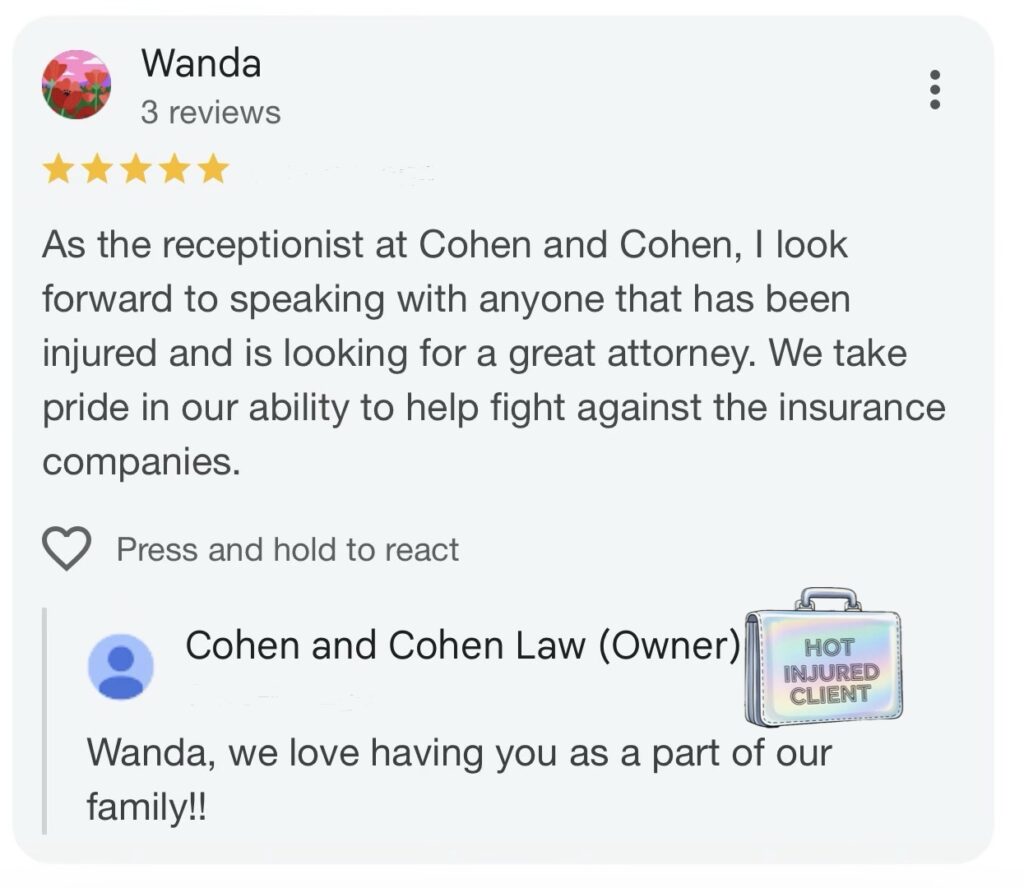
“As the receptionist at Cohen and Cohen, I look forward to speaking with anyone that has been injured and is looking for a great attorney. We take pride in our ability to help fight against the insurance companies.”
This is not a review. This a recruiting pitch by the person who literally answers the phones. There’s no mention of an actual case, outcome, or experience, just a thinly veiled ad (and a possible cry for help, because what is this?)
My former attorney, Adam Mann, who apparently moonlights as the firm’s PR manager, even jumps in to respond and plays along like this is normal, ethical and not embarrassing.
Google ended up flagging and deleting it months ago, along with a batch of other “reviews,” once it became obvious what was happening. And this is not rare, at least not on that particular review page, but more about that later.
Paralegals, office managers, family friends… if you think firms aren’t padding the numbers, you’ve never actually looked at a lawyer’s review page, especially after a major controversy.
Why Does This Matter?
Because this is the rule, not the exception. Fake reviews, staff reviews, and family hype are everywhere, especially in small to midsize firms where reputation is everything. It’s a desperate attempt to drown out any criticism before it gets noticed. If you trust the surface, you’re setting yourself up the same way people buy a house based only on the photos (and are shocked when they finally see it up close and personal).
Why the Star Rating Standard Doesn’t Apply to Big Firms
Let’s talk scale. Morgan & Morgan isn’t just a law firm; they’re the biggest in the country, maybe the world. Their reviews? A mountain, tens of thousands. And, yes, some of their Google ratings hover around 4.4 out of 5 stars, which sounds almost “average” in today’s world of artificially boosted 4.9s.
But here’s the catch: when you actually read those one-star reviews, most of them come from people who never even got past the intake call. We’re talking about clients who called hoping for a million-dollar settlement, only to be told by an intake specialist that their case wasn’t viable, or didn’t meet the firm’s criteria. Cue the “this place is a scam, no one called me back” outrage.
Volume Changes Everything
When you’re handling tens of thousands of cases, not every single person is going to walk away happy. Morgan & Morgan gets reviews from everyone: the person with a billion-dollar TBI, the person who was bitten by a dog at Walmart, and the person who just wanted to vent at someone, anyone. Their average gets dragged down, not by bad lawyering, but by sheer volume and unmet expectations.
Why This Actually Makes Them More Legitimate
Ironically, the lower rating, when combined with the massive number of reviews, is a sign that the firm isn’t playing the fake review game. They don’t need to. A 4.4 star average on 20,000+ reviews is more real than a boutique firm with 48 reviews and a “perfect” 5.0. It means you’re seeing a true cross-section of outcomes, not a handpicked portfolio of happy endings.
The Lesson: Look for the Outliers, Not the Average
If you want to get real insight, don’t look at the average rating. Look at the detailed stories. The most credible reviews, good or bad, will tell you exactly what went right (or wrong), name names, and lay out what actually happened, not just “thanks to my team.”
So if you’re weighing a giant like Morgan & Morgan against a small, 5-star “miracle worker,” ask yourself: who’s showing you the truth, and who’s gaming the system?
The Billboard, the Bus Bench, and the Never-Ending Jingle 🎶
The attorney search doesn’t just start with a Google review. It usually starts with a face on a bus bench, a guy who shouts in every local TV slot, or a radio jingle that gets stuck in your head for days. If you’ve ever caught yourself humming a lawyer’s phone number, you’re not alone: advertising works, and personal injury law is the Super Bowl of legal marketing.
Why Do We Fall For It?
Familiarity Bias: We trust what we’ve seen a hundred times, even if we’ve never actually met the person. That attorney with the best “tough face” on a billboard feels more legit than the guy quietly winning trials no one hears about. Repetition breeds familiarity, not expertise.
Promises of Big Settlements: These ads are always about “maximum recovery,” “no fees unless you win,” and “free consultation.” You’re not really picking a lawyer, you’re being sold the idea of one.
Emotional Hooks: Notice how every ad tries to hit you where you live? Kids in the backseat, the family minivan, the “trusted by your neighbor” angle; it’s about belonging and trust, even if that trust is built on repetition, not substance.
The Problem with Picking an Attorney Because of Ads
They’re Playing a Volume Game: The biggest advertisers aren’t looking for a handful of complex cases. They want every fender-bender, slip-and-fall, and dog bite in a hundred-mile radius. You are a number in the call log, not a bespoke client.
The “Closer” Phenomenon: The person in the ad may never touch your case. You’ll deal with intake specialists, then junior associates, and maybe (maybe) someone senior if your case is worth more than a used Honda.
Ads Don’t Tell You How They’ll Handle Your Case
What you see: smiling families and giant checks.
What you don’t see: the dozens of cases quietly dropped after intake, the settlements offered before anyone even reviews your file, the fact that the face on the billboard may never even read your medical records.
The Referral & Kickback Pipeline: The Legal Industry’s Worst-Kept Secret 🤝
If you think attorney referrals are about finding you the best fit, you’re already halfway down the rabbit hole. Behind every friendly “let me introduce you to my colleague,” there’s often a quiet handshake (and sometimes a direct cash transfer) that has nothing to do with your best interests.
How It Actually Works
Firm A splashes cash on ads and takes your call, but the moment your case doesn’t fit their cookie-cutter criteria, you’re passed to Firm B (or even C or D) with zero transparency. In Florida, it’s perfectly legal for attorneys to pay referral fees to each other (sometimes up to 25% of the total attorney fee). You will never see a line-item for this. You’ll rarely be told up front. And you’re definitely not going to see any of it coming back to you if the case resolves.
Why Is This So Unethical
You Are a Commodity: On paper, you’re a person. In the system, you’re a file with settlement potential and referral value. Some law firms exist solely to be intake machines and hand you off for a piece of the action.
Referrals ≠ Quality: The “recommendation” you get may have nothing to do with your case and everything to do with internal quotas, deal swaps, or last quarter’s underperformance.
No Real Oversight: Bar rules require disclosure, but in practice, most people don’t read (or receive) the fine print. Many firms bury referral agreements in the retainer or never mention them at all.
The Gen Z & Millennial Revolt
Younger clients are allergic to this kind of shady behavior. They grew up on YouTube exposés and TikTok “lawyer reacts” where attorneys roast each other for exactly this behavior. The moment a lawyer says, “You’d be a better fit for our partner firm,” they see red flags. People want proof of performance, not some mystery pipeline where your file is traded like a baseball card.
Word of Mouth: The Only “Review” That Counts 🗣️
Everything up until now is just noise if you’ve actually got a real person vouching for a law firm. The internet wants you to believe that five-star averages and flashy marketing are proof of skill, but the only thing that actually moves the needle is a real-life recommendation. Not your neighbor’s “I saw their ad during Judge Judy” or your cousin’s “the guy with the dog on the billboard,” but someone you know who put their neck (and their case) on the line and came out the other side happy.
I’ll give you a real example: Someone I know personally chose Morgan & Morgan after a catastrophic injury which required being in a wheelchair. He wasn’t swayed by billboards, hashtags, or Google’s star count, he just wanted results. He had a good experience, got what he needed, and would use them again.
Meanwhile, my former attorney tried to convince me I would “hate” Morgan & Morgan, swore I’d get lost in their machine, and told horror stories to scare me off. I ignored him, made my own decision, and so far, I’ve had zero issues. The onboarding was smooth, communication has been clear, paralegals and legal assistants are supervised and not trying to actively sabotage my case, and I haven’t been ghosted or gaslit about coverage or case value.
Word of mouth isn’t just more trustworthy, it’s usually brutally honest. People will warn you about shady paralegals, flaky lawyers, and if they’re lucky, who actually came through. It’s not sanitized, it’s not curated,and it isn’t padded with cousin reviews or referral fees. If you want to cut through the smoke and mirrors, ask around: Who did you actually use? Would you use them again? What’s the real story behind those stars?
When it comes down to it, every other method is just window shopping. Word of mouth is the only filter that matters.
Pro Tip:
Don’t let reviews, ads, or referrals do your thinking for you. The only way to know if a lawyer is the real deal is to talk to real people who’ve worked with them, and to ask detailed questions
Authentic word-of-mouth is never vague, never generic, and always includes the unfiltered reality: good, bad, or complicated. Your goal is to get a clear picture before you ever sign a retainer. Everything else is just sales fluff.